
The Gallery of the Absurd
From Observation to Intervention
by Robert J. Aragon
Over the past two decades, numerous cartoons—many associated with The New Yorker—have explored the relationship between humor and art. Often elegant, intelligent, and engaging, these works combine incisive humor with sophisticated draftsmanship and visual wit. Many center on the experience of viewing art itself. Visitors stand before paintings, make observations, and deliver compressed one-line reactions. While successful on their own terms, they approach art from the outside and from a distance.
The Gallery of the Absurd departs from a different premise.
It invites viewers to enter canonical works rather than merely observe them. The paintings are specific, the artists named, and the images rendered with a fidelity approaching exact replication. Recognition is immediate, but recognition is only the beginning. By encountering these works from within, the familiar may become newly visible, and once seen in this way, it can be difficult to see the original painting in quite the same way again.
The collection has been created for museum visitors, collectors, and others who have spent years looking at, studying, and thinking about art. Many of these viewers do not simply recognize the paintings; the paintings already exist in their imaginations before they encounter them again.
Created for exclusive distribution to museum stores and related cultural venues, it will not be sold through any mass market retail platform such as Amazon or Barnes and Noble.
Within these works, the figures embedded in canonical paintings cease to be silent and inert. They acquire voice, agency, and, at times, a more fully human presence. They speak back, argue, complain, negotiate, and occasionally challenge their creators. Christina insists that Andrew Wyeth paints her closer to the porch. Whistler’s Mother negotiates the terms of her posing while smoking a cigarette. Ingres’s Woman in Blue reveals a vanity and self-possession long concealed beneath the formalities of portraiture. Picasso’s Les Demoiselles d’Avignon emerges not from artistic revelation but from a chance encounter at a cocktail party. Marilyn Monroe teases Andy Warhol about his endless repetitions of her image.
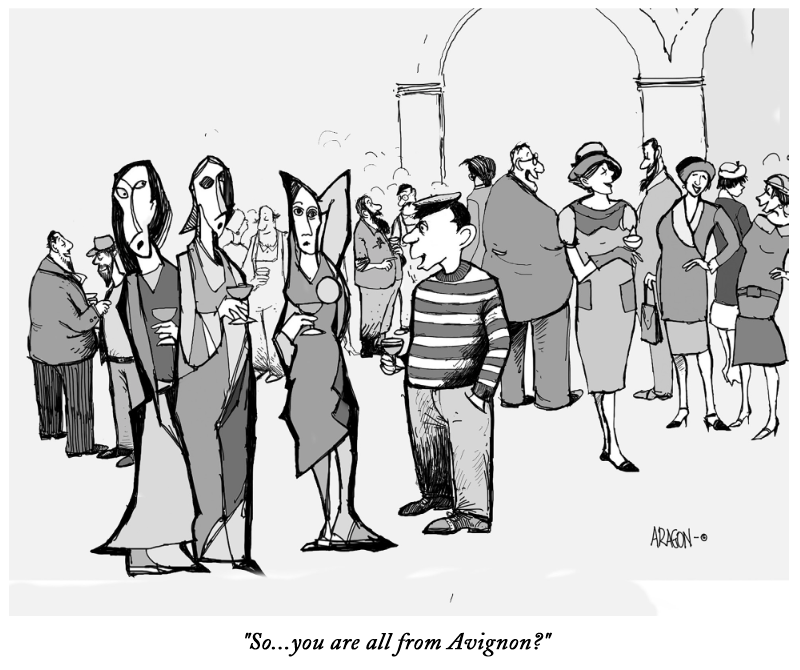
In many of these works, the grandeur of cultural masterpieces collides with recognizably human concerns. By introducing a single unexpected element, the familiar is made strange again, inviting viewers to see these works with fresh eyes. The result is not to diminish the original works but to bring viewers into a more intimate relationship with them.
The collection also dissolves the boundaries of history. Artists confront one another across decades and even centuries. Leonardo da Vinci challenges Marcel Duchamp over his defacement of the Mona Lisa. Willem de Kooning reveals to Robert Rauschenberg that the drawing he erased was merely a copy. Rembrandt’s Night Watch becomes an armed Neighborhood Watch enforcing correct grammar. Canonical works are not simply revisited; they are reimagined and reinterpreted from within.
The humor within these works does not come from outside but emerges from the logic, history, assumptions, and cultural memory already embedded within the originals. The strongest works do not merely attach jokes to famous paintings; they draw upon tensions, contradictions, and implications already present within them. They are not merely visual gags. They are interpretations compressed into a single image. The humor resides not merely in content but in context.
Although humor remains the primary vehicle, it is not always the destination. Occasionally the collection moves beyond humor altogether and enters more reflective territory. In The Potato Eaters, a family living below subsistence sets food aside for Vincent van Gogh, an act of quiet generosity and shared humanity. In Elegy to the Spanish Republic, Robert Motherwell confronts a more troubling question: whether greatness in art can ever justify the human suffering that inspired it.
The result is a collection that seeks not merely to amuse but to reopen familiar works, allowing viewers to encounter them from unexpected perspectives and discover meanings that may have been present all along, waiting to be seen. Humor is the entry point, not the destination. What endures is the altered way of seeing.
